

 Tiếng Việt
In many organizations, task assignments still happen through familiar methods: sending emails, messaging in group chats, discussing tasks directly, or noting them in Excel files. These approaches may seem simple and flexible, but as organizations grow, they quietly become a source of operational disruption.
This is because enterprise management is not simply about assigning a task. It is about ensuring that the task is executed by the right person, through the right process, within the right timeframe, and with clear accountability. When task assignments are handled manually, the entire operational chain of a business can easily become fragmented, lacking transparency and difficult to control.
When Tasks Are Separated from the Workflow
One common misconception in management is treating task assignment and workflow management as the same thing. In reality, these are two completely different concepts.
A company’s operational process is always a sequence of interconnected steps, where each task is transferred from one individual or department to another following a logical order. When a task is not embedded within a workflow, it exists merely as an isolated task, without a broader operational context.
A true workflow must clearly illustrate the flow of work—from initiation, processing, and approval to completion—with defined control points and responsibilities. If data or tasks are not passed between stakeholders through a logical flow, it is no longer a workflow but simply a set of disconnected tasks.
In environments where tasks are assigned manually, the connection between tasks and workflows almost disappears. Each task is communicated through different channels—scattered across emails, messages, meetings, or personal files. When organizations need to track progress or trace responsibility, they often have to search for information again instead of being able to observe the entire flow of work.
The Hidden Costs of Manual Task Assignment
The limitations of traditional task assignment methods are not only about inconvenience; they also create significant operational costs that are often difficult to recognize.
According to studies on modern workplaces, an average office employee spends up to 58% of their working time on low-value activities, such as searching for information, exchanging emails, or following up on task progress.
Meanwhile, labor market surveys in Vietnam indicate that:
- 72% of enterprises struggle to control work progress
- 63% report cases of assigning tasks to the wrong person, duplication, or overlooked tasks
- 59% of SMEs still manage internal work through emails, Excel files, or fragmented chat groups
These figures reflect a clear reality: most organizations are still operating with unstructured task management systems. As workloads increase, the absence of centralized management tools leads to fragmented information and a series of consequences such as delayed progress, unclear accountability, and wasted resources.
Processes Exist, but They Do Not Truly “Operate”
Many companies have already established well-documented business processes in the form of guidelines, diagrams, or internal regulations. However, when it comes to real operations, those processes are often not executed properly.
The problem is not the absence of processes, but the fact that processes are not directly connected to daily work.
A common example is the contract approval process. On paper, the process may include clearly defined steps: proposal creation, legal review, financial approval, signing, and archiving. In reality, however, these steps often take place through emails, messages, or informal discussions.
As a result, companies struggle to answer seemingly simple questions:
- Which step of the process is the contract currently in?
- Who is responsible for handling it?
- Has the processing time exceeded the SLA?
- If delays occur, where exactly in the process do they originate?
A process truly exists only when it is operated through a system, where each task is automatically linked to a step in the workflow. Otherwise, the process remains merely a reference document, while actual work continues to be handled manually.
From Task Assignment to Accountability Management
The fundamental difference between traditional task assignment and modern management lies in the ability to control responsibility and processing timelines.
In manual environments, task assignment often stops at simple reminders. The assigner lacks tools to monitor task status in real time, while the executor lacks a structured mechanism to report progress or transfer the task to the next stage.
When work is embedded within a workflow system, however, every task clearly defines:
- The responsible person
- The process step within the workflow
- The completion deadline (SLA)
- The execution status
This enables organizations to shift from management based on manual communication to management based on operational data.
Research on process automation shows that implementing workflow automation can significantly reduce processing time and minimize errors. In one experimental study on process automation, the processing time of a business workflow was reduced from 185 seconds to approximately 1.23 seconds, while nearly eliminating errors caused by manual operations.
This demonstrates that the true value of technology lies not only in accelerating processes but also in creating consistency and transparency in operations.
When Processes Become Actions
In the context of digital transformation, enterprises are increasingly recognizing that digitizing processes is not simply about digitizing documents or forms. The more critical objective is to transform processes into actionable systems that can be monitored and controlled.
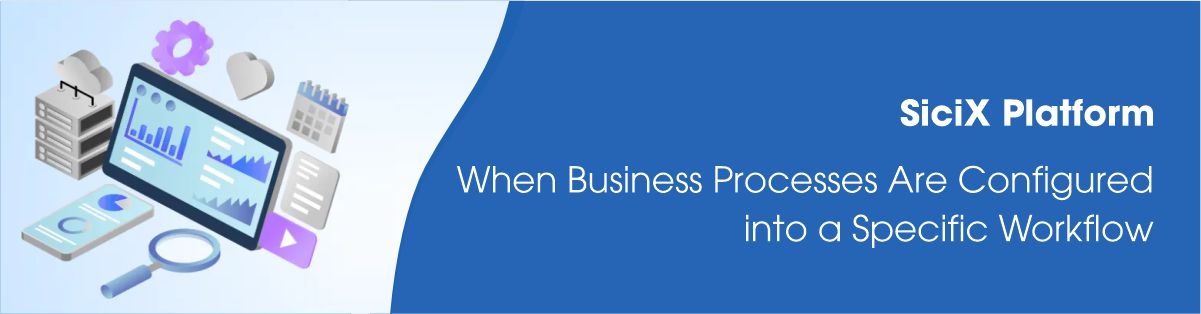
Operational management platforms such as SiciX are designed with this philosophy: each business process is configured as a specific workflow, where tasks are initiated, transferred, and tracked directly within the system.
Instead of assigning scattered tasks, work is embedded into the workflow from the beginning. When a task is created, the system automatically determines the process step, responsible person, SLA deadline, and execution status. The entire workflow becomes visible in real time, allowing leaders to observe the organization’s operational progress clearly and intuitively.
From a management perspective, this creates a fundamental shift: businesses no longer simply assign tasks, but instead manage the flow of work.
From Disconnected Tasks to Process-Driven Operations
As organizations grow, the number of tasks generated daily can reach hundreds or even thousands. If these tasks continue to be handled manually, operational disorder becomes almost inevitable.
Transitioning from manual task assignment to workflow-based management helps businesses address multiple challenges simultaneously: improving accountability transparency, controlling progress, reducing errors, and optimizing collaboration across departments.
More importantly, when work is closely integrated with processes, organizations gradually form an operational system that can be measured and continuously improved.
This marks the shift from “processes on paper” to “processes in operation”—where each task is no longer an isolated activity but part of a controlled workflow managed by the system.


Block "blog" not found