

 Tiếng Việt
In many organizations, workflows are already well-established. However, when it comes to evaluating operational effectiveness, an important question often arises: Are tasks being completed on time and meeting the expected performance standards?
If a company only stops at assigning tasks or tracking completion status, its operational management lacks a critical element: measuring the performance of the workflow itself. This is why modern organizations are increasingly emphasizing the monitoring of SLA and KPI within workflows.
In the context of digital transformation, SLAs and KPIs are no longer compiled manually in Excel reports; instead, they are recorded directly from operational systems. This enables business leaders to assess organizational performance based on real-time data.
SLA and KPI: Two Layers of Measurement in Process Management
In operational management, SLA (Service Level Agreement) and KPI (Key Performance Indicator) are two commonly used metrics to assess the effectiveness of task execution.
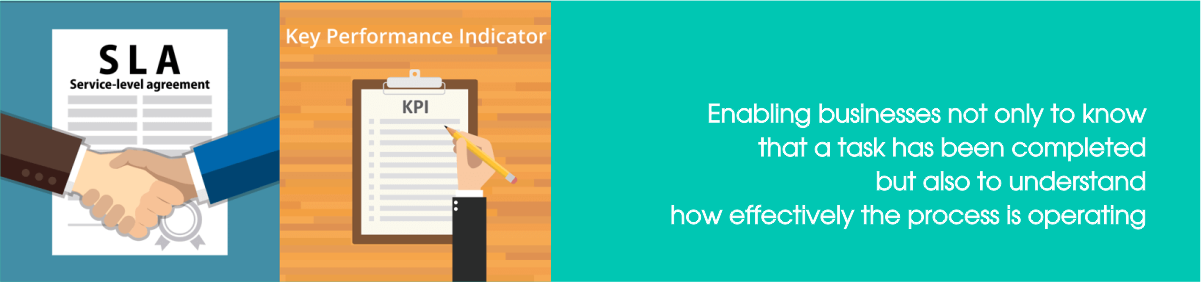
SLAs are typically defined at the level of individual workflow steps. These metrics specify the timeframes or service standards that must be met. For example, a customer support request may need to be responded to within four hours, or a contract may need approval within 24 hours.
KPIs, on the other hand, are used to evaluate operational performance at the system or department level. Through KPIs, businesses can determine the on-time completion rate of processes, average processing time, or the proportion of overdue tasks.
When these two measurement layers are integrated, an organization not only knows whether a task has been completed but also understands how efficiently the workflow as a whole is operating.
Challenges of Tracking SLA and KPI Manually
Although many organizations define SLA and KPI metrics in process documentation, actual monitoring often faces significant limitations. A common reason is that task management is dispersed across multiple tools such as email, internal chat, or Excel spreadsheets.
In this fragmented model, work data is not centralized, making performance measurement inaccurate. It becomes difficult for businesses to precisely determine when a task starts or ends, and KPI report consolidation can be time-consuming.
According to McKinsey research, approximately 50% of work activities in organizations can be automated with existing technology, yet most organizations have not yet leveraged this potential to improve operational efficiency.
Another report on workflow automation shows that companies implementing workflow automation can reduce process cycle time by about 30% and increase employee productivity by approximately 18% by eliminating manual tasks.
These figures demonstrate that effective SLA and KPI monitoring is not only a management issue but also directly linked to the technology infrastructure supporting an organization’s workflow management.
Conditions for Effective SLA Monitoring in Workflows
For SLAs to accurately reflect operational performance, each task must be associated with a specific step in the workflow. This allows the system to clearly determine the current stage of work, the responsible party, and the processing deadline for each step.
Another critical factor is the system’s ability to automatically capture processing time data. Task creation time, start time, and completion time must be recorded in the system to ensure SLA accuracy.

Additionally, alert mechanisms play a key role in progress control. When a workflow step is about to exceed its SLA, the system should automatically notify the responsible person to take timely action. This allows businesses to proactively manage risks rather than only identifying issues after delays occur.
From SLA Data to Operational KPI Systems
Once workflow processing data is fully captured, organizations can build operational KPIs based on actual workflow data.
These metrics provide leaders with a holistic view of operational performance. For example, the percentage of tasks completed within SLA can reflect the organization’s adherence to process standards, while average process time helps identify bottlenecks.
In modern enterprises, this data is often displayed on real-time operational dashboards, enabling managers to quickly detect issues and make informed decisions to improve processes.
The Role of Workflow Platforms in SLA and KPI Monitoring
In contemporary operational management models, monitoring SLA and KPI is increasingly tied to workflow management platforms.
These systems allow businesses to define SLAs for each workflow step, track processing status in real time, and automatically aggregate data to generate operational KPIs.
SiciX’s workflow management platform is designed with this approach. Every task generated within the system is directly linked to business processes, while processing time milestones are recorded automatically. This enables businesses to monitor task progress, identify potential delays early, and build KPI dashboards based on actual operational data.
When workflows are digitized and integrated with performance measurement systems, processes are no longer static documents but become operational systems that can be continuously monitored and optimized.
Data-Driven Process Management
In an increasingly competitive environment, operational efficiency is a key determinant of organizational competitiveness. Efficient organizations not only design effective workflows but also continuously measure and improve them based on data.
Monitoring SLA and KPI increases transparency in task management, enhances control over progress, and allows early detection of operational bottlenecks. When workflow data is fully captured, processes become operational systems that can be analyzed, evaluated, and continuously optimized.
This approach reflects a broader trend in digital transformation: turning processes from descriptive documents into data- and technology-driven operational systems.


Block "blog" not found