

 Tiếng Việt
Manufacturing companies do not lack software. What they lack more is a system capable of connecting data, processes, and management decisions into a unified flow.
A day at a factory may begin with production planning, followed by raw material inventory checks, order progress tracking, purchase request processing, quality control, and finally reports submitted to executive management. Every activity generates data. But the important question is: Are all these data telling the same story about the business?
Production planning knows how much the company needs to produce. The warehouse knows how much raw material is available. Procurement knows which orders are pending. The production floor knows whether a production line is running or stopped. Accounting knows the costs incurred. Sales knows the orders and delivery commitments.
If all this data resides in different systems, is updated at different times, and must be manually consolidated, a company may have digitized individual business functions without actually having a digital management system.
This is becoming an increasingly important challenge as manufacturing companies enter the next phase of digital transformation.
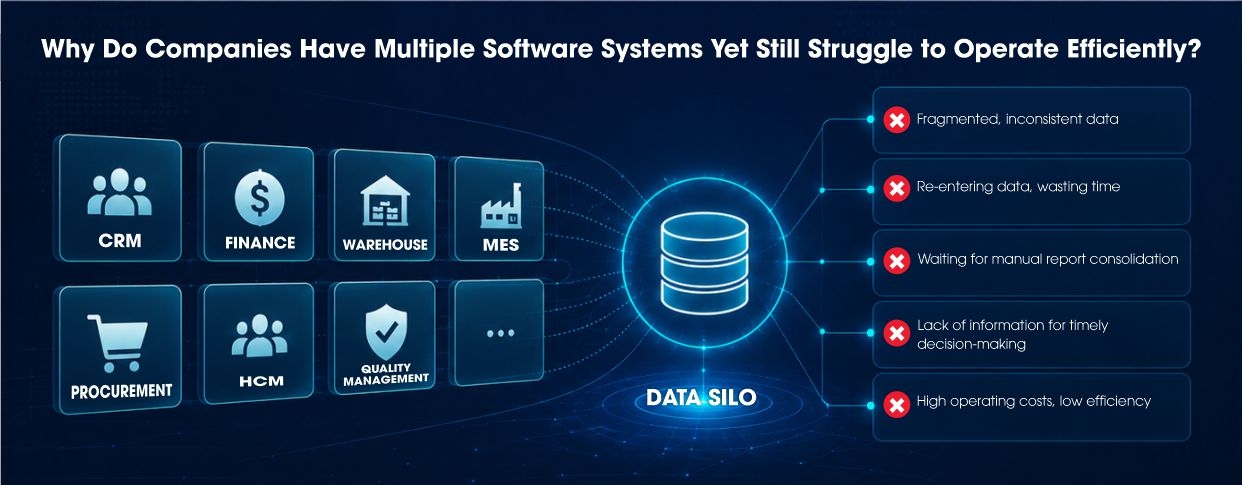
When More Software Makes It Harder to See the Bigger Picture
Digitizing individual business functions is a common and entirely understandable approach.
Accounting has accounting software. The warehouse has a warehouse management system. HR uses HCM. Sales has CRM. Procurement has its own system. Manufacturing has MES or another specialized system.
Each system may solve its specific business problem very effectively. But when the number of systems increases without a corresponding increase in integration, a paradox begins to emerge:
A company has more data, but not necessarily more useful information.
A change in an order can affect the production plan. The production plan, in turn, affects raw material requirements. Raw material requirements are linked to procurement, inventory, cash flow, and ultimately delivery schedules.
In essence, these are not independent problems. They are links in the same operational chain.
If technology systems digitize each individual link without connecting the entire chain, companies still have to rely on people to “connect” the data. Excel spreadsheets, emails, shared files, and confirmation calls therefore continue to exist even after companies have made significant investments in technology.
This is precisely the difference between digitizing individual business functions and digitizing operations as a whole.
Digital Transformation Is Not Measured by the Number of Software Systems
A company may deploy multiple systems and still fail to achieve a corresponding level of digital maturity.
The number of software applications does not reflect the maturity of management. What matters more is whether data is connected, whether processes are integrated, and whether information reaches the right people at the right time to support decision-making.
Deloitte’s 2025 Smart Manufacturing and Operations Survey, which surveyed 600 manufacturing executives, found that 92% of respondents believe smart manufacturing will be a primary driver of competitiveness over the next three years.
What is noteworthy is not only this figure, but also the direction behind it: companies are shifting their focus from simply adopting more technologies toward building data and technology foundations for automation, analytics, and AI adoption.
In other words, the question is no longer “Do we have the software?”, but rather “Are our software systems and data coming together to form a unified management system?”
From Data to Decisions: Three Layers That Need to Be Connected
The digital transformation challenge for manufacturing companies can be viewed through three layers.
First: Data
Orders, raw materials, inventory, production plans, machinery, quality, workforce, costs, and financial information are all important sources of data.
But data only creates real value when companies can connect and leverage it within a unified view.
Second: Processes
Data must move together with the flow of work.
When is a purchase request created? Who approves it? What happens if it exceeds the budget? When the production plan changes, which departments need to be updated?
Workflow and automation only create meaningful value when they enable companies to turn these processes into a flow that can be monitored, controlled, and measured.
Finally: Decisions
This is the ultimate destination of a digital management system.
Executive leadership does not need hundreds of additional reports. They need to know:
What is happening? Why is it happening? How significant is the impact? And what action needs to be taken?
When data and processes are connected, companies have the foundation to build executive dashboards, conduct data analytics, and progressively apply AI to forecasting, alerts, and decision support.
AI Should Not Be the Starting Point
AI is opening up many opportunities for the manufacturing industry, including demand forecasting, anomaly detection, production optimization, analytics, and decision support.
But AI cannot turn fragmented, poorly standardized data into a reliable management system.
Deloitte’s 2025 Manufacturing Industry Outlook also emphasizes the importance of data quality for AI adoption, as data quality, data validation, and data contextualization remain challenges for manufacturing companies.
Therefore, companies should follow a logical sequence:
Connect Data → Standardize Processes → Analyze → Automate → AI
This may not be the most appealing path from a communications perspective, but it provides a practical foundation for new technologies to create value.
Where Should a Manufacturing Company Start?
A company does not necessarily need to begin with a large-scale digital transformation project. Nor does it need to replace its entire existing system.
A more appropriate starting point is to review the company’s most critical operational flows.
From orders to planning, from planning to procurement and inventory, from raw materials to production, and from production to quality and delivery.
Companies need to identify where “breakpoints” exist: places where data has to be re-entered, Excel files sent back and forth, phone calls made for confirmation, approvals awaited, or reports manually consolidated.
These are precisely the areas that should be prioritized for transformation.
At the same time, companies need to identify the core data used by multiple departments and directly influencing management decisions.
Digital transformation, therefore, should not begin with the question:
“Which software should we buy?”
It should begin with:
“What does the company want to manage better?”
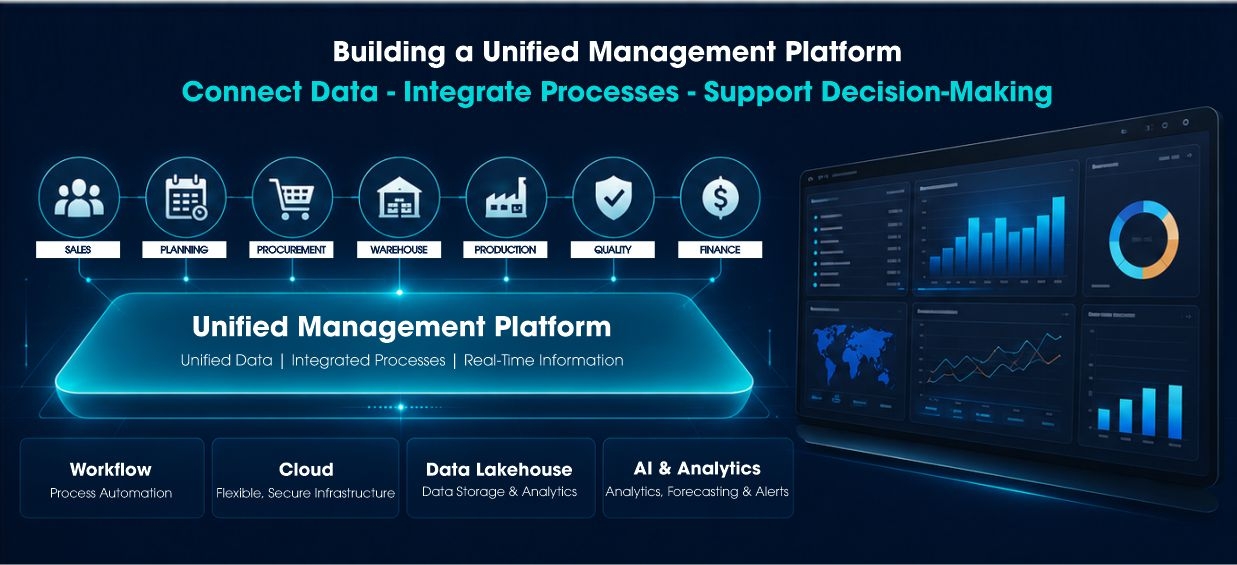
From “Software” to a “Management Platform”
This is also how SiciX approaches digital transformation for businesses.
Rather than viewing digital transformation as the deployment of additional software for individual departments, SiciX Digital Business Platform is designed as a platform that connects management and operational activities through a unified data architecture.
For a manufacturing company, the operational flow may begin with:
Sales → Planning → Procurement → Warehouse → Production → Quality → Finance → Executive Management
The important point is not to put every business function into a single software application, but to connect data and processes across business functions so that information can flow seamlessly throughout the organization and executive management can gain a holistic view.
On this foundation, capabilities such as Workflow, Cloud, AI, and Data Lakehouse can be further leveraged to support automation, analytics, alerts, and data utilization.
This approach also enables companies to move forward step by step rather than having to transform the entire system at once.
Digital Transformation Should Start with a Holistic View
Manufacturing companies do not necessarily need to digitize everything at once.
Nor do they need to pursue every new technology.
What matters first is being able to see the entire operational flow, identify the breakpoints, and determine which data truly needs to be connected.
From there, companies can progressively move through the following stages:
Connect Data → Standardize Processes → Automate → Analyze → AI → Intelligent Operations
This is a long journey.
But when the foundation is built correctly, each subsequent investment does not stand alone. Instead, it continues to create additional value for the entire system.
Therefore, the difference does not lie in how many software applications a company has.
It lies in whether those software systems, data, and processes are working together to create a unified management system.
Digital transformation is not about digitizing individual departments. It is about building an operating system in which the entire organization can see and work from the same data picture.


Block "blog" not found