

 Tiếng Việt
Over the past few years, the concept of “Digital Office” has become increasingly common in enterprise digital transformation strategies. However, alongside the growing popularity of the term comes a notable reality:
many businesses still interpret Digital Office in a rather simplified way – assuming that deploying internal chat tools, corporate email systems, cloud storage, or task management software is enough to complete the digitalization of the workplace.
This approach has led many organizations into a situation where “the more tools they adopt, the more complex operations become.” Employees may find online collaboration more convenient, yet at the management level, businesses still struggle to monitor progress, synchronize data, or track operational performance in real time.
In other words, many organizations have merely “moved work online” without truly building a unified digital operating environment.
Digital Office Is Not Simply a Collection of Workplace Applications
One of the major reasons behind the current misunderstanding is that Digital Office is often equated with “collaboration tools.”
In practice, operations in many businesses still follow a familiar model: communication through chat platforms, document sharing via email, file storage on cloud drives, and progress tracking through Excel sheets or manual reports. Each tool solves a separate problem, but the overall workflow lacks end-to-end integration.
At a small scale, this model may not immediately expose significant issues. However, as businesses expand and the volume of data, departments, and workflows increases, fragmented information gradually becomes a major operational barrier. Executive teams face difficulties in monitoring real-time work status, while departments spend excessive time confirming information, searching for data, or resolving overlapping responsibilities.
What is worth noting is that most enterprises today do not lack software. What they lack is a unified operational environment – a place where data, workflows, and collaborative activities are connected within a single system instead of being scattered across isolated platforms.
When Businesses “Digitize Tools” but Not “Digitize Operations”
One common paradox in digital transformation is that companies may invest heavily in technology while management efficiency fails to improve proportionally. The reason lies in the fact that digitalization efforts often stop at the level of deploying tools rather than restructuring operational models.
In many organizations, departmental data still exists independently. Sales teams work on CRM systems, accounting departments operate on separate platforms, HR communicates through internal chat systems, while leadership receives information through end-of-day or end-of-week summary reports. Each system may function effectively within its own scope, yet the enterprise lacks an integrated “connection layer” capable of creating a seamless data flow for management purposes.
As a result, work processing speed no longer depends on technological capability, but rather on manual coordination between people. The more disconnected platforms an organization uses, the harder it becomes to maintain transparency and overall operational visibility.
This is also why many digital transformation experts today believe that the Digital Office challenge is no longer about “which software to use,” but about how enterprises organize their operating models within a digital environment.
Digital Office Is Fundamentally a Management Challenge
From a business management perspective, Digital Office is not merely a space where employees communicate online. It is an environment where all operational activities are connected and controlled in real time.
Unlike the traditional “digital collaboration” mindset, the modern Digital Office model focuses on data synchronization, process standardization, and enhanced operational governance. In this model, tasks are not only assigned and executed, but also tracked, traceable, and measurable in terms of performance.
This becomes especially important in an environment where businesses increasingly depend on decision-making speed. When leadership teams cannot access real-time operational visibility, organizations are more likely to respond slowly to emerging issues, while hidden operational costs continue to increase.
Current trends show that many businesses are shifting from “tool-based working” to “system-based operation” — meaning operations are managed through a unified system rather than a collection of disconnected tools.
From “Digital Workplace” to “Digital Operations Center”
Globally, the concept of the Digital Workplace is gradually evolving. While these platforms were previously designed mainly for collaboration and internal communication, they are now becoming the “digital operating infrastructure” of enterprises.
Instead of simply supporting communication, modern systems increasingly focus on integrating workflows, operational data, approvals, KPIs, and executive reporting within a unified environment. The goal is no longer just to make employees work more conveniently, but to help businesses operate more transparently and maintain stronger operational control.
In Vietnam, this trend is also becoming more evident among businesses entering growth and expansion phases. As the number of departments, workflows, and data sources continues to increase, the demand for a highly integrated digital workspace is becoming a priority instead of continuously adding separate tools.
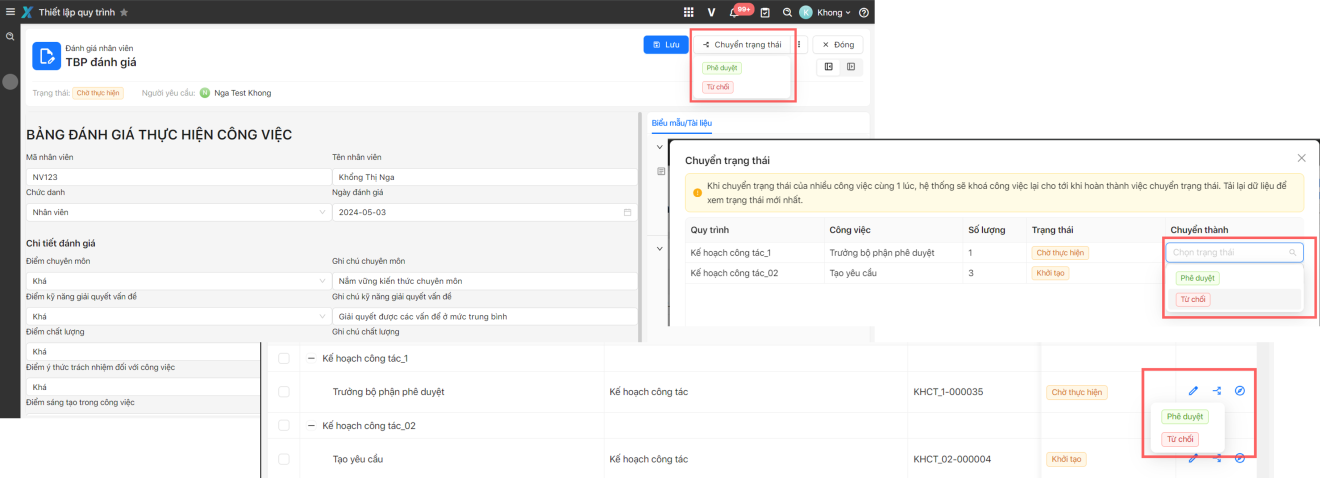
This is also the direction pursued by many enterprise management platforms today, including SiciX – where Digital Office is approached as a unified digital operating environment that connects data, workflows, and executive management rather than focusing solely on internal communication.
Digital Office Is No Longer Just an IT Matter
During the early stages of digital transformation, Digital Office initiatives were often viewed as technology projects managed by IT departments. However, as businesses move into phases of operational optimization and scalable growth, this challenge is increasingly becoming a strategic management issue.
In reality, the competitiveness of modern enterprises no longer depends solely on products or revenue. It also depends on operational speed, cross-department collaboration capabilities, and the ability to make decisions based on real-time data.
Therefore, an effective Digital Office should not be measured by the number of applications a company owns, but by its ability to connect all operational activities within a unified, transparent, and controllable system.
That is also the point at which the “digital office” is no longer simply a place where employees work online, but becomes the operational foundation of the modern enterprise.
Explore the SiciX Digital Office Solution


Block "blog" not found